Friday, May 18, 2018

Art News: The JM Edition

I haven't been posting much lately, but if you follow this blog you know that I write about exhibitions I've seen. And for the past couple of years, I've been publishing occasional posts on women artists in my Mothers of Invention series. (I have one coming in June, another in July.) But this post is all about me. One of the great things about being at it for several decades is that now don't have to go looking for opportunities; invitations just arrive. This spring there have been a preponderance of invitations. Allow me to share a peek with you. 


Crazy Beautiful III
At Kenise Barnes Fine Art, Larchmont, N.Y.
June 8-July 27
Reception: Friday, June 8, 6:30 to 8:30; I'll be there

I'm delighted to be included in this show, which offers visual pleasure as its theme thanks to Kenise Barnes's unerringly elegant eye. Nine artists are included in the show, including Jackie Battenfield, Mary Judge, and me.

Read the online catalog here.


A chromatic selection of my Silk Road paintings for Crazy Beautiful, all 2018, encaustic on panel, 18 x 18 inches
Below: Some individual paintings for the show


Silk Road 410


Silk Road 414


Silk Road 415


Silk Road 412

__________________


Three exhibitions in Provincetown, Massachusetts, to coincide with the International Encaustic Conference

May 25-June 24
Reception: June 1, begins at 7:00

This ambitious exhibition offers visitors an opportunity to examine a curated selection of 24 artists whose work in wax or encaustic is aligned along a spectrum of aesthetic inquiry. A full catalog, cover shown left, is available to purchase or to view online at no cost.

Installation, clockwise from top left: Silk Road 404, 401, 353, 402; all 2018 (except 353, 2017), encaustic on panel, 18 x 18 inches
Below: Some individual paintings in the show

Silk Road 401

Silk Road 404


Installation view by Susan Lasch Krevitt

. . . . . .

The Blues
Adam Peck Gallery
142 Commercial Street
June 1-6
Opening: Friday, June 1, 6:00 to 10:00 p.m.

Every year Adam and Marian Peck organize a large show in their small gallery to coincide with the Conference. This year it's inspired by cobalt, cerulean, turquoise, and all the other hues that evoke  jazz, evening, sadness,and the endless range of aquatic hues at the tip of Cape Cod. 


Silk Road 369, 2018, encaustic on panel, 12 x 12 inches

. . . . . .


.
Keep it 100
Curator: Winston Lee Mascarenhas
OnCenter Gallery
352 Commercial Street
June 1-14
Reception: June 1, 6:00 p.m.

From the curator: "The contemporary vernacular of our theme is about keeping it real . . . the invitational message thus being inclusive of varied innovative, compelling, and unique artistic expressions."  
Chromatic Geometry 26
These three paintings: 2015, encaustic on panel, 18 x 18 inches

Chromatic Geometry 27

Chromatic Geometry 30

__________

New York Art Lab
Osaka; traveling to Kyushu and Hiroshima

After a successful week in Osaka in early May, curator Shuhei Yamatani is taking his New York Art Lab--with artists such as Rene Lynch, Julian Jackson, and myself--on the road with  additional stops in Japan, including Kyushu and Hiroshima. This year Yamatani selected a number of my unique digital prints to include in the show.

The prints, approximately 8 x 8-inch images on archival 11 x 8.5 paper, began as a serendipitous fluke when, in the process of printing a Silk Road image, my printer began to run out of ink. Since printers are programmed to print no matter what, some interesting things happened to the image. Read more about them here.
Silk Trail 298


Silk Trail 342


Silk Trail 345


Silk Trail 362


__________

Coming in August

Chromatopia: An Illustrated History of Colour
By David Coles
Thames & Hudson, Australia


Last year paintmaker David Coles and painter Louise Blyton curated Chromatopia: A History of Colour in Art for the Tacit Gallery in  Melbourne, Australia. Since then Coles, the master paintmaker behind Langridge Oil Colours, has produced a book based on the research he did for the exhibition with images of work selected by Blyton. 
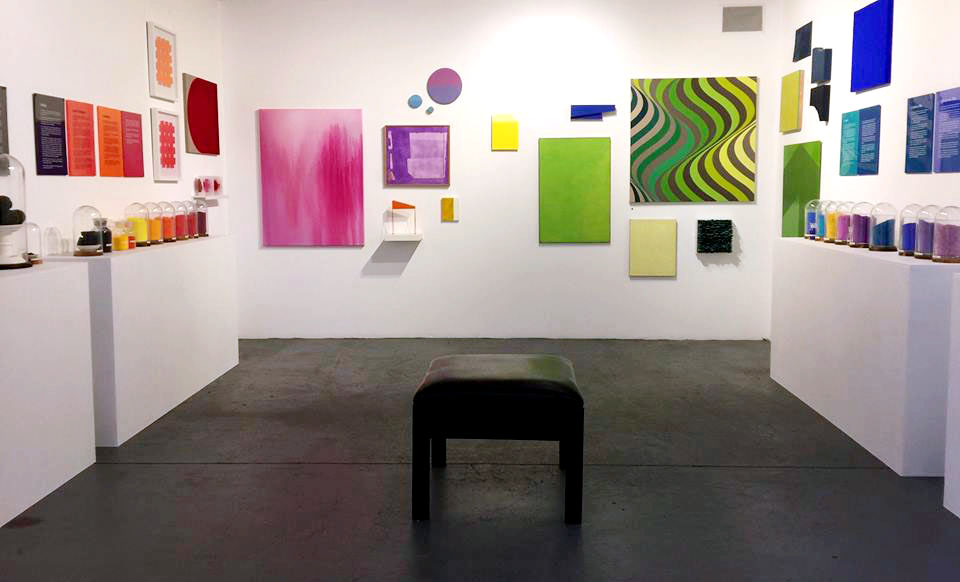
Above: Installation shot from the 2017 exhibition, courtesy of the curators

The book includes and international lineup of works by Samara Adamson-Pinczeski, Irene Barberis, TJ Bateson, Louise Blyton, Richard Bottwin, Peter D Cole, Kevin Finklea, Connie Goldman, Brent Hallard, Jeanne Heifetz,  Euan Heng, Ruth Hiller, Suzie Idiens, Ash Keating, Emma Langridge, Simon Leah, Tom Loveday, Joanne Mattera, James Austin Murray, Munira Naqui, Redbox Peter, Debra Ramsay, Michelangelo Russo, Marlene Sarroff, Wilma Tabacco, Jim Thalassoudis, Richard van der Aa, Don Voisine,  and Ian Wells.           .

Below: My Silk Road 207, 2014, encaustic on panel, 18 x 18 inches, seen on right wall of the installation above

I'll be back in touch in early September with another all-about-me post. I know it's a lot, but I hope you'll share this very full art year with me.

Friday, March 30, 2018

How To Diminish a Woman Artist? Focus on Her Clothes

It’s a good thing Georgia O’Keeffe’s ashes are scattered over The Pedernal Mountains of New Mexico, because if she were buried I’m pretty sure she would be spinning at a high velocity in her grave. Why? The W Magazine of a show about her that has been making the rounds. 


From the exhibition: Laura Gilpin (American, 1891–1979),  Georgia O’Keeffe, 1953
Gelatin silver print. The Amon Carter Museum of American Art, Fort Worth, Texas. Bequest of the artist, P1979.130.6. ©1979 Amon Carter Museum of American Art


Georgia O’Keeffe: Living Modern began at the Brooklyn Museum last year, guest curated by Wanda M. Corn, and has traveled to the Peabody Essex Museum, in Salem, Massachusetts, where it was given the name, Georgia O’Keeffe: Art, Image, Style. I skipped it when it was in Brooklyn because I was pretty sure I would be as pissed off by the show as I was annoyed by the concept. (What’s worse, the exhibition was part of A Year of Yes: Reimagining Feminism at the Brooklyn Museum, because nothing says “feminism” like like focusing on a woman’s appearance, eh?)

But the PEM is on my walking route when I’m in Salem, and as a Salem resident I get in for free, so I stopped in. I was right. What a way to diminish the artistic achievements of a woman artist: Feature her clothes and accessories! There are pitifully few big solo museums shows given to women artists, so this show feels like a mockery of their, our, struggles and achievements. O’Keeffe’s achievements in her time were formidable, and her paintings remain iconic, but let’s examine her shoes. Uh, no.

I am a regular visitor to both museums. The Brooklyn Museum houses the Elizabeth A. Sackler Center for Feminist Art—a unique opportunity to examine art from a feminist perspective—where it houses Judy Chicago’s iconic The Dinner Party on permanent exhibition. The Peabody Essex Museum has grown from a sleepy venue–which featured the odd combination of Native American arts and artifacts along with objects from Salem’s 18th century China trade—into a first-class contemporary art museum that has broadened its scope and holdings while retaining a bit of the quirkiness that brought it into being.

To be fair, O’Keeffe did have a distinct personal style, as seen in the splendid photographs of her, taken by Laura Gilpin, Philippe Halsman, Arnold Newman, Alfred Stieglitz, and others. But building an exhibition around how a woman artist dressed while displaying her paintings as a backdrop to the fashion is, frankly, sexist and insulting. (The New Yorker liked the show; so did Roberta Smith in The New York Times, though she writes, "
A problem is that the show runs out of paintings before it runs out of clothes and photographs"; The New Republic took a more circumspect look at O’Keeffe’s art and style.)

What’s next: Matisse and his Home Décor? Ad Reinhardt: Monochromatic Fashion Icon? Julian Schnabel: A Man and his Pajamas?  No, because male artists are defined by their paintings. Even Kehinde Wiley, the most sartorially expressive artist working today, is defined by his work. In GQ's long 2013 feature on him, How Kehinde Wiley Makes a Masterpiece, exactly one paragraph was devoted to his clothing.

The museum world can do better than what it has done for women. 

Saturday, March 24, 2018

Nobu Fukui and Francois Morellet: Maximal and Minimal

As always, one of the great things about gallery going in New York City is not only that you can see great art, but you can see a great variety of it at any given time even within a small  geographic area. So it is with two exhibitions up now: Nobu Fukui at Margaret Thatcher Projects and François Morellet at Dia: Chelsea. Fukui is the maximalist whose paintings sing with a heady mix of image, color, and texture. Morellet is the minimalist, whose paintings and sculptures whisper with spare lines and repeated elements.


 Details from Nobu Fukui and Francois Morellet


Entrance to Margaret Thatcher Projects, where Nobu Fukui's exhibition, Paradise, is up through April 7 


We start with Fukui. By all means spend some time viewing his paintings from a distance, but go in close to be enveloped by their presence. Fukui is not aiming for a narrative; he creates painted and collaged works that satisfy his sense of color and composition. Nevertheless, given the range of image-rich material he uses, your own sense of narrative may develop as you connect the dots. And I mean dots literally. Floating on the surface—well, embedded slightly into a film of acrylic—are thousands of plastic beads topped with a white-painted dot—which form a dimensional picture plane above the one composed of collaged images. I’ll tell you more as you scroll through the images.  
(Disclaimer: I wrote the essay to his catalog, which can be seen online here) 

Nobu Fukui, Mythic, 2017, beads and mixed media on canvas over panel; 90 x 90 inches

Front gallery installation view: Pool of Thought and Mythic

Pool of Thought, 2017, beads and mixed media on canvas over panel, 72 x 96 images
Detail below


From the side, the beads are seen as a kind of lens through which we see the composition. At the same time, they form a pointillist surface that hovers above it. The title of each painting comes serendipitously from the newsprint ground that the artist lays down before painting.


View of Mythic (proportions exaggerated by the panoramic lens) and Beautiful Room

Beautiful Room, 2017, beads and mixed media on canvas over panel,  30 x 96 inches
Detail below


From the back gallery looking toward the front: Paradise, the painting that gives the exhibition its title


Paradise, 2016, beads and mixed media on canvas over panel, 96 x 196 inches in four panels
(Make sure your screen is open wide enough to see the horizontal expanse of this image)

Three details below


Images are collaged onto a painted surface, which is overlaid with a layer of clear actylic into which thousands of plastic beads are scattered


. . . . .


François Morellet (1926-2016), about whom I knew nothing before viewing this exhibition at Dia:Chelsea, was a self-taught artist who relied on a reductive formal vocabulary of lines and geometric forms.  Seeing the show in Chelsea, my first thought was how the work was reminiscent of other art I was familiar with: One painting of concentric squares  suggested Frank Stella, another the zig-zag patterns seen in some Josef Albers early work (based on ancient architectural sites in Mexico) on view at the Guggenheim, and still others the earth geometry of Richard Long. Maybe this is just me needing to connect the dots, as I am wont to do. It’s a quiet show with a little humor in the way Morellet skews our expectation of geometry and reductivism. This and a related show in Beacon are up through June 2. 


Information unavailable
(The brochure offers numbered diagrams of each gallery, hard to decipher after the visit, given that Morellet's titles are based on idiosyncratic references. So just look and enjoy. I provide info where I can)

Ligne continue sur 4 plans inclines a 0°, 30°, 60°, 90° (Continuous line over 4 Tilted Planes), acrylic on canvas

Arc de cercle complementaires n°3 (Geometree n° 5C), 1983, wood and crayon

Foreground: 52 x 4 n° 3: cercles et demi-cercles (Quand j'ete petit, je ne faisais pas grand; When I Was Young I Did Not Work This Large), acrylic on canvas and wood

Information unavailable

 A selection of work. The two black and white works below are here shown in the far corner

4 doubles trames 0°, 22°5, 45°, 67°5 (4 Double Grids 0°, 22°5, 45°, 67°5), 1958, oil on wood,
Detail below


2 trames de grillage 12°, 79° (2 Wire Mesh Grids 12°, 79°, 1959, wire on painted wood
Detail below


Sphere


Tuesday, March 6, 2018

Mothers of Invention: Louise Nevelson


The great one


"We learned the artist is a woman, in time to check our enthusiasm. Had it been otherwise, we might have hailed these sculptural expressions as by surely a great figure among moderns. See them by all means--painted plaster figures and continuous-line drawings that take much knowledge from Picasso and from Mayan and Indian expressions. I suspect that artist is clowning--but what excellent equipment artistically."
--Cue, October 4, 1941


Louise Nevelson: Black and White took place at Pace Gallery on 24th Street recently. The lights were dim in the main gallery, whose walls were painted dark gray. This is how Nevelson had envisioned and presented an early show of her work. The eyes needed time to acclimate, and the camera did its best to capture what it saw as I photographed around the visitors.


Entering main gallery: Sculptures from the Fifties, Sixties, and Seventies
The sculpture at left is shown frontally in the image below

Untitled, late 1970s. wood painted black, 9'11" x 11'10" x 1'11"


Panning around the gallery
Foreground: Colonne II, 1959, wood painted black, 9 feet by 20 inches by 20 inches
Against the back wall: Untitled, late 1970s, wood painted black,  8'7" x 8' 4" x 1'6"
High on wall: Black Moon, 1961, black painted wood, 40 x 40 x 3.5 inches

This work was against the third wall in the gallery: Untitled (Sky Cathedral), 1964, wood painted black, 8'4" x 11' x 1'7"
There's a splendid image of this work on the gallery's website (scroll to the eighth of 15 images)

Detail below


Another gallery  held these dramatic white sculptures, set against the same dark gray walls
Dawn's Presence-Three, 1975, wood painted white, 123 x 127 x 99 inches


Foreground: Detail of Dawn's Presence-Three; back wall: Floating Cloud V, 1977, painted wood, 30 x 28 x 10 inches


Panoramic view looking toward the frontmost gallery with viewers for scale and  contrast


In the front gallery two walls contained a museum-like timeline  from Nevelson's birth in Kiev in 1899 through her childhood in Maine, to her long career in New York City, and then her death here in 1988, just shy of the century mark

As the list of her achievements grew, photos depicted an ever-more-dramatic Nevelson swathed in layers of sumptuous fabrics, furs, head scarfs--with her signature eyelashes

Despite the drama, there was the ever-present thumb on her early effort, as noted in the text below (from which I took the words that open this post). Still she persisted, and by 1962 she represented the United States at the Venice Biennale. Though noted for her monochromatic Constructivist assemblages in wood, during her long career Nevelson worked in a range of mediums: bronze, clay, even plexi.