Friday, October 6, 2023

No Treat for Women

Halloween is the modern celebration of the pagan Samhain, in which the veil between worlds is pierced and spirits make their way back into the land of the living. It is a lovely concept, so strongly held onto over the centuries, that even Christianity incorporated the ritual into a holy day, All Souls Day, on November 1.


Here in Salem, Massachusetts, where I live part of the time, Halloween is celebrated all month, mostly by tourists eager to dress as goblins and witches and by the businesses that cash in on the reveling. I hate the traipsing and traffic of the crowds. More than that, I hate the (typically unwitting) celebration of the barbarism practiced by Christians over the centuries.


 Image from the internet


As we crack open our Kit Kats, we might remember that branding a woman as a witch was a way to control her. And what better way to control her than by killing her—by burning, as was done in Europe in the Middle Ages and by hanging, as was done in Salem, Massachusetts. Consider Joan of Arc, who was burned at the stake in 1431 in Rouen, France, for being a heretic, sorcerer, and crossdresser. 


Burning continued in Puritan England for almost 300 years. According to the magazine Historic UK,From 1484 until around 1750 some 200,000 witches were tortured, burnt, or hanged in Western Europe.” 
I remember reading of advice offered to women of the time: Breathe deeply of the smoke so that you will be killed by asphyixiation before the flames char your flesh.


A depiction of Joan of Arc at the stake

Below, an image from the internet showing a baby tossed in for good measure (a reminder that terrorism has long been with "civilization")


The numbers were much smaller in Salem, and the manner of killing different, but the deaths were no less appalling. In a year between June 1692 and May 1693, 19 people were hanged as witches, 14 of them women, including the women whose names you see on the monument at Proctor’s Ledge in Salem. Tituba, an enslaved woman of Barbadian or indigenous South American origin, was reputedly the first woman to be accused. She was not hanged but spent a year in jail after accusing others of the crime. That “confession” was beaten out of her. After she was released, she disappeared from Salem’s historical record. (Of the five men, 81-year--old Giles Corey was pressed to death with heavy stones.)


Contemporary memorial to the women and who were hanged as witches at Proctor's Ledge, on Gallows Hill in Salem, Massachusetts, where the killings took place.
Photo Jim DeGennaro from the internet

Below, a closer view of one stone
Image from the internet


The inquisitioners in both England and Salem had a unique method of determining if a woman was a witch: dunking. They dropped a bound woman into a body of water. If she somehow survived, she was a witch and was burned or hanged. If she drowned, she was innocent.

If she escaped the flames or the noose, there were other punishments in store for an outspoken woman. In 16th- and 17th-century England and Scotland, her head might have been strapped into what was called a scold’s bridle. This was not just a muzzle, but a contraption that contained a metal plate that pressed on her tongue. In its most extreme form, the plate had a spike that pushed into the tongue itself. So much for having an opinion. 

Do I need to add that this unspeakably cruel punishment was meted out only to women?


Worse than being branded with a scarlet A,  the scold's bridle encased a woman's head. Presumably she was still required to keep house and care for her children

Below: the actual bridle was far more sadistic. And note the little bell atop the contraption. Clearly it was designed to add insult to injury, drawing attention to the woman when she ventured into the marketplace


Mussolini had a way to deal with independent women or those whom he saw as not conforming to his fascist ideas about how they should behave: For two decades he locked them away in mental asylums. Their families were so ashamed, that many women were refused return by their own families.

Our rights have always been tenuous and the punishments for our “transgressions” sadistic. The GOP  reminds us of this daily. Fight back! Enjoy contemporary Halloween, but donate--to Planned Parenthood, the ACLU, and to Democratic candidates at the local, state, and national levels. Vote Democratic.

And remember . . .


Sunday, November 27, 2022

Radical Chrome at Kenise Barnes Fine Art


Partial panorama of Radical Chrome at Kenise Barnes Fine Art: two by me, three by Audrey Stone, tondo by Julie Maren, three by Jenny Kemp, one by Mary Judge


What's the antidote to the waning light of the season? Color! I'm delighted to be sharing the walls at Kenise Barnes Fine Art with four other artists, all of whom are engaged with the power of pigment. The opening of Radical Chrome took place  a couple of weeks ago, but the show is up through January 15.

The gallery is located in Kent, Connecticut, in a cultural enclave that consists of contemporary structures and some restored barns that house art galleries, design and antique businesses, and artisanal food shopsthe aptly named Kent Barns. Kent is in the far western part of the state, just under two hours from Manhattan.  Let me take you on a clockwise tour from the entrance, which you see below.


Entrance to Kenise Barnes Fine Art

These images offer a more inclusive view of the show. Starting from the far left: a small work by me and two by Mary Judge


Joanne Mattera, Tutto 5, 2022, oil and oil pastel on panel, 16 x 12 inches


Opposite the entrance, these two gorgeous pieces by Mary Judge, who is known for her symmetrical, often mandala-like paintings and works on paper. She uses the Italian Renaissance technique of spolvero to delineate the composition 

Historically spolvero was used to transfer a design from a perforated paper template to a canvas by pouncing a small bag filled with fine charcoal dust. Contemporary master Judge uses the technique not as an intermediary element but to create the actual drawing using pigment powder

Above: Mary Judge,  Primavera Pop 14, 2022, powdered pigment on paper, 34.5 x 34.5 inches framed
Below:  Primavera Pop 28B, 2022, powdered pigment on paper, 34.5 x 34.5 inches framed


Continuing around the gallery: Joanne Mattera, Audrey Stone 


Above: Joanne Mattera, Tutto 9, 2022, acrylic on canvas, 48 x 36 inches

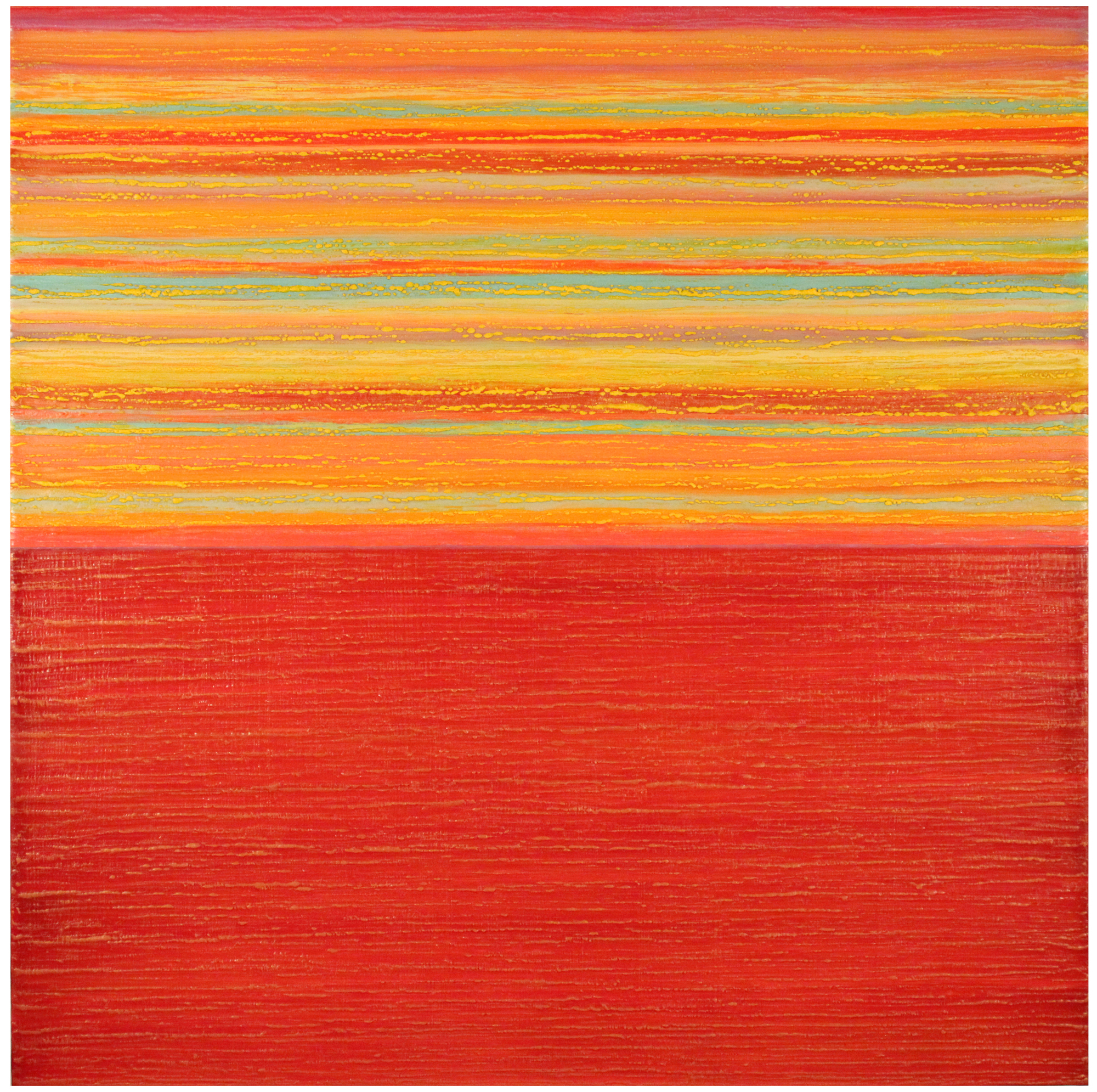
My new series, Tutto, continues the themes I have been working with for some time: a divided field, emphasis on the horizontal, and saturated color

Below: Tutto 8, 2022, acrylic on canvas, 48 x 36 inches


Audrey Stone, Julie Maren


Audrey Stone, Coast to Coast 7, 2022, acrylic and flashe on canvas, 40 x 30 inches


Often inspired by personal events, Audrey Stone's vibrational works are by turns meditative and retinally stimulating, the result of minute shifts in color progression.  Each band of color may represent a single days work


Passing Through, 2022, acrylic on canvas, 50 x 40 inches


Coast to Coast 6, 2022, acrylic and flashe on canvas, 40 x 30 inches


Audrey Stone, Julie Maren, Jenny Kemp


Julie Maren, Bouquet, 2022; acorn tops, plaster, paint, brass; 50 inches diameter and six inches deep

Maren's connection to the natural world is direct, as she uses acorn tops as the repository for color.  Installations are dimensional, jumping the boundaries between painting and sculpture
 
Detail below


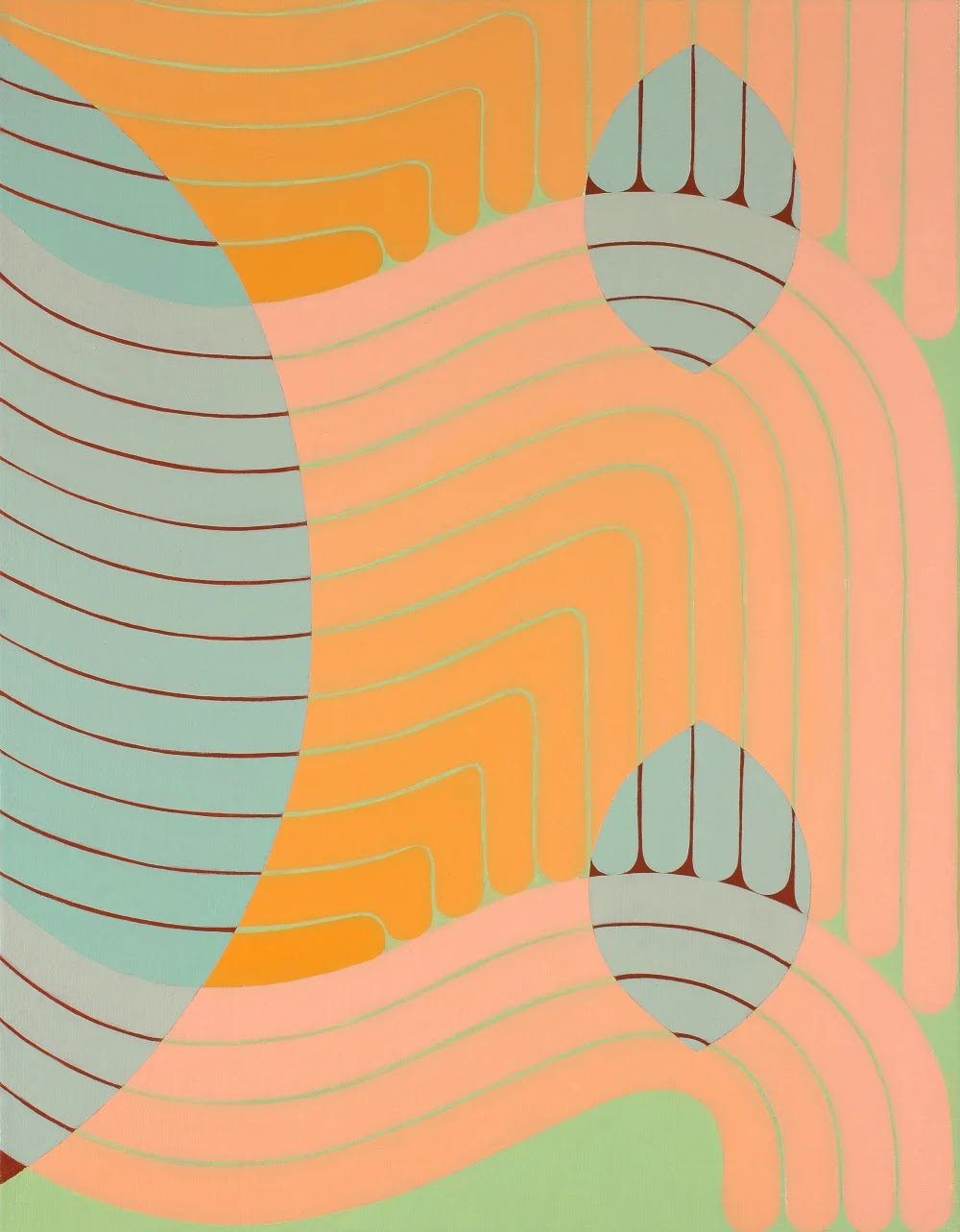
Jenny Kemp, Midsection, 2022, acrylic on linen mounted on canvas, 40 x 32 inches

Kemp's biologically inspired paintings employ pattern and rhythm, suggesting organic growth. Gradations of hue deepen the sense of accretion and development.


Tandem, 2022, acrylic on linen mounted on canvas, 18 x 14 inches


Braid, 2022, acrylic on linen mounted on canvas, 25 x 22 inches


Continuing around the gallery: Jenny Kemp, Mary Judge


Mary Judge, Primavera Pop 03, 2022, powdered pigment on paper, 34.5 x 34.5 inches framed


Pollinator, 2020, oil on linen, framed 9.5 x 9.5 inches


Yellow Gemelli, 2020, oil on linen, 7.5 x 7.5 framed


Pink Kiss, 2020, oil on linen, 7.5 x 7.5 framed


Radical Chrome is up through January 15. 
More info about the gallery
More info about the show 
More info about Kent Barns      

Saturday, November 19, 2022

All and Everything

My work from the past year is largely horizontal. On a bisected field (square or vertically rectangular) there are bands of color on the top half over a more or less monochromatic bottom half. I call the series Tutto because in it I have painted in encaustic, my mainstay medium for the past 30 years, as well as acrylic, oil, and oil pastel. In other words, everything. (Tutto is Italian for everything.) Also, for me color is everything, the simpler the composition, the better.


View from Newbury Street in Boston, where my solo, Tutto, is up through November 29 at Arden Gallery

In the past few months I have shown, or am showing, Tutto paintings in several venues. In this post are installation shots from Arden Gallery in Boston, where my solo, the eponymous Tutto, is up through November 29; a little teaser from Radical Chrome at Kenise Barnes Fine Art in Kent, Connecticut, where I am part of a five-artist show that focuses on, yes, color (I’ll soon have a full-length post on that show, which is up for a long stretch); and Pique, a group show that opened the season at Marcia Wood Gallery in Atlanta in September.

If you are familiar with my work, you'll see that the later paintings in the Silk Road series feature the same horizontally banded and bisected field. Transitions are interesting as one idea morphs into another. Tutto continues the bisected field while Silk Road will double back and resume its identity as a series of color fields (I'm not finished with that series yet!). 

 This painting is in the Arden window: Tutto 14,  2022, acrylic on panel, 48 x 40 inches


View into Arden's front gallery
Photo courtesy of the gallery

In the front gallery: Tutto 13,  2022, acrylic on panel, 48 x 40 inches


In the front gallery: Tutto 11,  2022, encaustic on panel on panel, 36 x 36 inches

Below: View around the corner into the middle gallery


Tutto 18, 2022, encaustic on panel, 18 x 18 inches


In the middle gallery: Silk Road 488, 2020, encaustic on panel, 24 x 24 inches
This is one of the paintings in transition from Silk Road to Tutto


In the middle gallery: Tutto 20, 2022, encaustic on panel, 24 x 24 inches

. . . . .


Radical Chrome at Kenise Barnes Fine Art, Kent Connecticut, through January 15

I'll have another post soon that focuses exclusively on Radical Chrome and its five participating artists. For now, here's a little peek. You can see more on the gallery's website.


Tutto 9, 2022, left, and Tutto 8, each acrylic on canvas, 48 x 36 inches


Panorama with the five artists: two by me, three by Audrey Stone, tondo by Julie Maren, three by Jenny Kemp, and one by Mary Judge. You'll see more from each artist in the next post


Tutto 9, 2022, acrylic on canvas, 48 x 36 inches

. . . . . .


Pique at Marcia Wood Gallery, Atlanta, September 2022

Pique opened the gallery's fall season with a selection of work by gallery artists: Benjamin Britton, Robert Chamberlin, Deborah Dancy, Scott Eakin, Mary Engel, Deb Lawrence, Tim McDowell, Kim Ouellette, Joe Peragine, Robert Sagerman, and myself. You can see more on the gallery's website.

Recent at Marcia Wood Gallery, Atlanta
Installation view from the group show, Pique


Tutto 7, 2022, acrylic on canvas, 48 x 36 inches


Tutto 16, 2022, acrylic on canvas, 48 x 36 inches


Tutto 17, 2022, acrylic on canvas, 48 x 36 inches


Tutto 15, 2022, acrylic on canvas, 48 x 36 inches


Catalog with all the Tutto paintings to date, plus a selection of works from Mezza and Riz 


A conversation in the Summer 2022 issue of The Art Section between Deanna Sirlin and myself on "Contemplating the Horizontal." Click here to read